

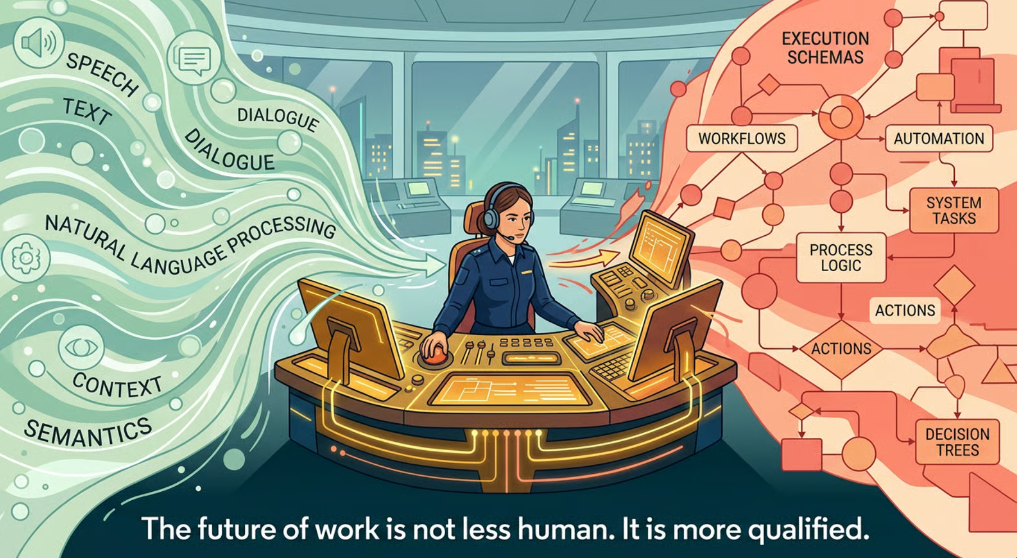
Where AI Still Needs Humans — The Collision Between Language Intelligence and Operational Determinism.
Two computational regimes — probabilistic language and deterministic execution — are colliding inside every enterprise that buys AI. The friction in that collision is where qualified humans become permanently necessary. This article explains why, at three levels of depth, and lets you read where you are most comfortable.
An AI model can generate exquisite language. An organization still has to execute. Those are not the same thing — and the gap between them is widening, not closing, as AI moves from chat windows into operational systems. The closer AI gets to running the work, the more sharply it collides with a different computational regime: the deterministic, rule-bound, audit-required world of organizational execution. That collision zone is not a bug. It is structural. And it is exactly where qualified humans become permanently necessary — not because AI is “bad,” but because two different kinds of intelligence are meeting, and somebody who understands both has to stand at the seam.
Read where you’re comfortable. Skip what you’re not. Nothing is hidden — everything is invited.
This article is written at three depths. Each section is tagged with the tier it serves. Start where you fit, follow the curiosity if it pulls you further, and stop when you’ve got what you came for.
The strategic argument
The collision is real, structural, and not solved by buying smarter AI. It explains why hiring and capability budgets will grow, not shrink, around AI-augmented work.
Start at the collision →What it looks like in the work
Concrete failure modes, the schedule-a-meeting example, the translation catalog, and the operational implications for AI Operators, Context Engineers, and governance leads.
Start at the failures →Why the architecture forces it
JSON Schema’s semantic gap, the native-tongue problem, constrained decoding limits, and the emerging middleware stack — without leaving the executive reader behind.
Start at the architecture →The Collision, in One Sentence. All readers
AI systems excel at generating language. Organizations still operate through deterministic systems, governance structures, operational accountability, and contextual ambiguity that must be resolved.
That single sentence is the entire thesis. Everything else in this article is evidence, examples, and implications. If you read no further, that sentence is enough — and it should change how you think about hiring, governance, and capability development for the next decade.
The closer AI moves toward operational execution, the more important governance, oversight, and orchestration become. Maturity does not eliminate the need for qualified humans. Maturity creates it.
Two Regimes, One Enterprise. Executive
Every modern organization now spans two fundamentally different kinds of computation. They share buildings, budgets, and org charts — but they obey different rules. Understanding them as separate is the first step.
| Dimension | Language IntelligenceWhat modern AI does best | Operational DeterminismWhat organizations actually require |
|---|---|---|
| Mode of operation | Probabilistic | Deterministic |
| Tolerance for ambiguity | High — ambiguity is the natural medium | Low — ambiguity must be resolved before action |
| Output structure | Flexible language continuation | Rigid schemas, fixed parameters |
| Treatment of context | Semantic inference | Explicit, governed, audited |
| Definition of “correct” | Plausibly responsive | Compliant with policy and verifiable against record |
| Failure mode | Plausible-sounding wrongness | Process violation, audit gap, regulatory finding |
| Time horizon of a decision | The current cycle | Reconstructable months or years later |
Each column is a legitimate and powerful computational mode. Each was designed and optimized for what it does. The trouble is that the modern enterprise needs both, and the seam between them does not maintain itself.
That seam is the work. Every AI Operator, every Context Engineer, every AI Governance Lead — every role in the emerging operator class — exists because some qualified human has to stand at the boundary between the two regimes and reconcile them, case by case, decision by decision.
Where the Collision Actually Hurts. Practitioner
The clearest way to feel this collision is to watch what happens to a simple human request as it crosses from language into execution. Consider an everyday office instruction:
To a competent human assistant, that sentence is unambiguous enough. To a tool-calling AI agent, it can trigger a cascade of translation problems — each one capable of slowing, confusing, or derailing enterprise AI deployment if no qualified human is governing the workflow.
Translation Failure Catalog — One Sentence, Eight Problems
- Date parsing — “next Friday” is ambiguous within five days of a current Friday. Which week, exactly, is “next”?
- Time-of-day interpretation — “Afternoon” is a 6-hour window. What’s the right anchor — 1pm, 2pm, 3pm? Whose convention applies?
- Timezone resolution — Whose afternoon? Requester’s? Finance team’s? Headquarters’? In a global company, these can differ by 12 hours.
- Recipient disambiguation — Which finance contact? The CFO? The controller? The accounts-payable lead? “Finance” is a department, not a person.
- Authorization scope — Does the requester have standing to book the CFO directly, or does it require routing through an executive assistant?
- Calendar permission — Even if the right person is identified, does the AI have permission to read their availability and write to their calendar?
- Business-rule compliance — Is the meeting purpose disclosed? Some organizations require subject lines on calendar invites for compliance reasons.
- Escalation logic — If the chosen slot conflicts, what is the fallback? Push to the following week? Suggest alternative times? Notify the requester and wait?
Each one of those problems is a tiny instance of the collision. The language was complete. The operation was not. Some qualified entity — currently a human, possibly forever a human — has to resolve every single one before the meeting actually gets scheduled. The AI can do an excellent first draft. It cannot own the resolution.
Multiply that single example across every meaningful workflow inside a modern organization — procurement, HR actions, customer responses, financial transactions, regulatory filings, marketing campaigns, code deployments — and you can feel why operational AI maturity creates more demand for qualified human judgment, not less.
The same collision appears in software development — and here the consequences land faster and harder, because operational systems are unforgiving of naming inconsistencies in ways that calendar ambiguity is not.
Observed in the Field — The LinkedIn Field Rename
- The request: A stakeholder asks an AI coding assistant to update a LinkedIn profile field name for consistency.
- The language: The model understands the request perfectly — it recognizes the intent, maps it to a naming convention, and produces a seemingly cleaner result:
linkedinUrl→linkedin_url. - The operational reality: That single character change — a camelCase-to-snake_case conversion — silently violates the downstream system. Frontend bindings break. TypeScript definitions misalign. API contracts that reference the original field name fail. Any integration consuming the field name gets a value it doesn’t recognize.
- What the model missed: The AI understood the field name linguistically. It had no awareness of the architectural dependencies, the existing contract surface, or the downstream systems that had been built around the original naming convention.
- What stopped the damage: A qualified human reviewer who understood the operational context rejected the change before it merged. That rejection is not a failure of AI — it is the governance layer working exactly as it should.
An AI model may successfully understand a request linguistically while simultaneously violating operational assumptions embedded elsewhere in the system. The model was not wrong about the language. It was uninformed about the architecture. That distinction is everything — and it is the gap that no amount of model sophistication fully closes, because the architecture lives in the enterprise, not in the model.
One more observation from the same scenario: the repository had no CLAUDE.md file — no operational context document telling the AI how the codebase is structured, what naming conventions are enforced, or which contracts are downstream dependencies. That absence is not a minor oversight. It is the context engineering gap made visible. When operational context is not deliberately assembled and provided, the model fills the void with inference — and inference against an incomplete picture produces exactly this kind of plausible-sounding, operationally dangerous output.
The language was complete. The operation was not. That gap, multiplied across every workflow in the enterprise, is the entire reason the AI Operator role exists.
Why the Architecture Forces This. Technical
For readers who want to understand why this collision is structural — not a temporary limitation that the next model will fix — the underlying architecture is worth walking through. The executive reader can safely skip to the next section. The practitioner reader can follow along; nothing here requires a CS background. The technical reader will recognize the territory.
The Native Tongue Problem. Large language models are trained on text — prose, conversations, documentation, code. Their native output is probabilistic text continuation. Tool calling, on the other hand, requires output like:
{
  "tool": "calendar_create_event",
  "date": "2026-05-29T14:00:00Z",
  "attendees": ["cfo@company.com"]
}
That is not language. It is machine-operational syntax — a structured representation that has to be exact down to the character. The model is being asked to translate from its native medium (language) into a medium it was not optimized for (deterministic schema). Vendors have done remarkable engineering work — function calling, structured outputs, constrained decoding — to bridge that gap. The bridge works. But the structural tension remains: the model is doing two jobs at once, and the second job is not what it was originally built to do.
The JSON Schema Semantic Gap. When a tool defines a parameter as "date": { "type": "string" }, the schema enforces structural validity — it must be a string. But schemas do not capture semantic expectations: whether "next Thursday", "2026-05-29", "5/29/2026", or "May 29, 2026" is the intended format. The model can produce all four. Three of them will probably break the downstream system.
Richer schema metadata (formats, examples, enums, constraints) closes some of this gap. But schemas live at the syntax layer. The questions they leave unanswered — which customer ID, which calendar, under what authority, against which policy — are semantic, contextual, and organizational. Schemas cannot answer them, and no amount of schema refinement will change that. Those answers live in the operating context of the enterprise, which is exactly where human-operated governance lives.
The Context Management Problem. A modern AI agent connected to Drive, GitHub, MCP servers, Slack, a CRM, and a calendar has access to an exploding operational surface. The model must decide, in real time: what context to retrieve, what to ignore, how much to inject into a prompt, when to escalate. These are not language problems. They are operational judgment problems — the same kind of judgment that defines senior professional work in any complex domain.
The Emerging Mitigation Stack. The industry’s response to these collisions is converging on a recognizable architecture: tool-use fine-tuning at the model layer, constrained decoding to enforce structure, orchestration middleware to validate and route, retrieval policies to manage context, and governance frameworks (ISO/IEC 42001, NIST AI RMF) to assign accountability. Notice what every one of those mitigations has in common: they assume a qualified human or team designed and continues to maintain them. The architecture is admitting, in code, that humans are required.
The technical detail does not change the executive conclusion — it strengthens it. The collision between language intelligence and operational determinism is not a current-generation problem that GPT-N or Claude-N+1 will erase. It is a structural feature of how the two regimes work. The bridge can be engineered to be smoother, faster, more reliable. The bridge cannot be designed away.
What This Means for the Workforce. Executive Practitioner
Once you accept that the collision is structural, the workforce implications follow almost mechanically. The closer AI gets to operational execution, the more the enterprise needs qualified humans at the seam. Five role categories are already emerging to do that work, and every one of them is a credentialed or certifiable profession in formation.
AI Operators
Govern AI-augmented workflows end-to-end. Define scope, design context packages, set approval architectures, own the audit trail. Vol. 05 of this series filed the federal occupational profile for this role.
Context Engineers
Build the documentation, retrieval, and metadata flows that let AI operate against accurate organizational context. The deterministic plumbing under the probabilistic intelligence.
AI Governance Leads
Operationalize ISO/IEC 42001, NIST AI RMF, and adjacent frameworks. Convert international standards into enterprise practice, audit against them, defend the chain of evidence.
Workflow Orchestrators
Design and supervise the multi-step processes in which AI is one of several contributors. The modern equivalent of the ERP process owner, with a vastly wider span of integration.
Human Oversight Specialists
Resolve the residual ambiguity, escalation, and edge cases that the architecture cannot. Often domain experts (legal, medical, financial) layered onto the orchestration stack.
Notice the pattern: every one of these roles requires qualification. Education, credentialing, sustained professional development. The mature operational fields we already trust to handle high-stakes work — aviation, nuclear operations, cybersecurity, quality management, financial audit — all converged on the same pattern. As the technology matured, the demand for qualified humans rose, the credentialing infrastructure built up, and the field stabilized around licensed and certified professionals. AI is following the same arc.
The Parallel That Settles the Argument. All readers
Aviation did not get safer by removing pilots. It got safer by professionalizing them. Type ratings, recurrent training, simulator hours, medical certifications, regulatory oversight. The technology of flight became more automated, more reliable, more sophisticated — and the qualifications required of the humans who operate around that technology became more rigorous, not less.
The same is true of nuclear operations, where reactor control is now heavily computerized but reactor operators are licensed individually by federal regulators. The same is true of clinical medicine, where decision-support AI is now common but physicians are credentialed more rigorously than they were before the technology existed. The same is true of cybersecurity, where automated defense is the norm and CISSP, CISM, and CISA are required to lead the function.
In every case, the introduction of advanced automation into a high-stakes operational domain produced not a contraction in qualified human roles, but an expansion — with credentialing, governance, and continuous professional development as the operating norm. The pattern is so consistent across domains that the burden of proof now lies on the claim that AI will somehow be different.
Aviation did not get safer by removing pilots. It got safer by professionalizing them. AI will not deliver enterprise value by removing humans. It will deliver value by professionalizing the humans who operate alongside it.
What the Frameworks Already Assume. Executive Practitioner
If the field-level evidence is not enough, the formal evidence is already on the record. International AI governance frameworks — ISO/IEC 42001, the NIST AI Risk Management Framework, the EU AI Act, and adjacent standards — have built into their structure the assumption that named, accountable, qualified humans will operate AI systems. The frameworks do not describe future jobs. They describe roles that the standards presume already exist, even though most organizations have not yet staffed them.
Read ISO/IEC 42001 carefully and you find role expectations for AI risk owners, AI impact assessors, AI system operators, and AI governance leads. Read the NIST AI RMF and you find expectations for AI actors across the lifecycle, with documented accountability at each stage. These are not optional. They are the assumed substrate on which the entire framework rests.
The standards have written the job descriptions. The work now is staffing them.
The Conclusion That Reorganizes the Argument. All readers
If we accept that language intelligence and operational determinism are structurally different computational regimes, and that the modern enterprise needs both, and that the seam between them must be operated by qualified humans, then the dominant narrative about AI and the workforce is not just incomplete — it is inverted.
The popular argument says: AI is powerful, therefore humans are at risk. The architectural argument says: AI is powerful, therefore qualified humans are more necessary — at higher altitudes of judgment, with more rigorous credentialing, with greater accountability, and with significantly higher strategic value. The replacement narrative was wrong not because it was pessimistic, but because it was looking at the wrong layer of the system.
The future of work in the AI era is not less human. It is more qualified.
The collision between language intelligence and operational determinism is permanent. The qualified humans who stand at the seam are the future of professional work.
Two computational regimes. One enterprise. The seam between them is where the value is built.
AI will not deliver operational value by replacing humans. It will deliver operational value by demanding more qualified humans at higher altitudes of judgment — and rewarding them accordingly.