

Dr. Bill / Thought Capital · Vol. 04
AI Is Becoming a Junior Engineer — But Someone Still Has to Run the Shop.
The operator’s layer between AI experimentation and organizational value — and why the next 24 months will sort companies into those who built it and those who only talked about it.
Most enterprise AI conversations are still stuck one layer too shallow. We keep arguing about which model is best, which prompt is cleverest, which tool to license. Meanwhile, the question that will sort winners from also-rans in the next two years is being missed entirely: what can AI reliably do inside a governed workflow? That single shift in the verb, from say to do, changes everything about how organizations should invest, train, and structure work.
The Conversation Has Moved.
A year ago, the question was: what can AI say? That question is essentially answered. Today’s models produce capable, often excellent text, code, analysis, and synthesis. The new question — the one almost no one is publishing about yet — is whether AI can reliably DO real work inside a system the organization actually controls.
That single shift in the verb, from say to do, changes the budget, the training, and the org chart of every company serious about AI.
The Four-Layer Operating Model.
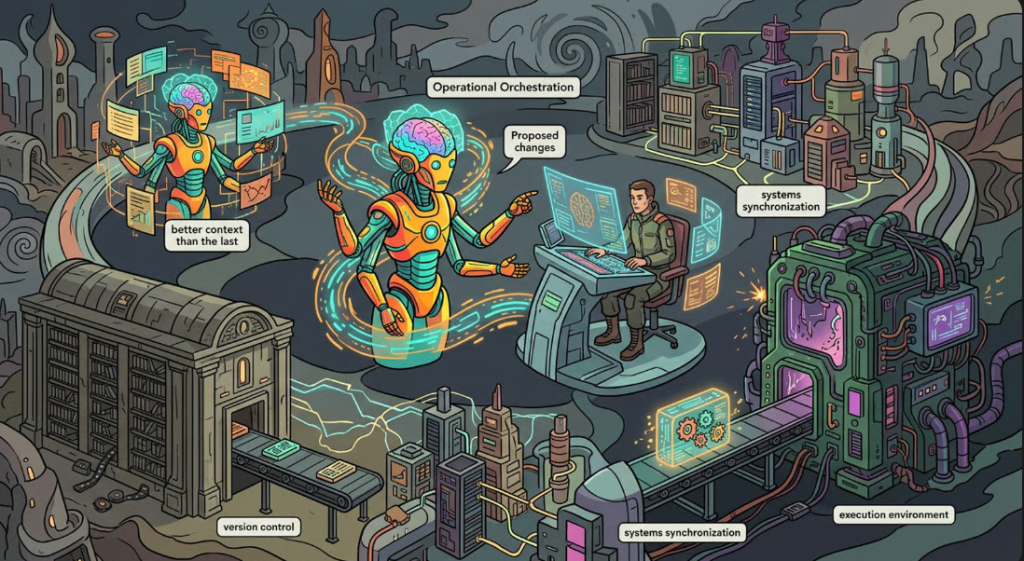
To see where value is actually produced, think about AI work through four operating layers. Each one has an organizational analogue every leader already understands.
The Model
A capable junior engineer or analyst. Smart, fast, willing — and like every junior, in need of scope, review, and supervision. The model is a contributor, not a department.
The Execution Environment
The shop floor. Terminals, repos, applications, data pipelines — the place where AI proposals actually become work product. Most “AI training” never teaches this layer at all.
Version Control
Institutional memory and audit trail. Every meaningful AI-assisted change is recorded, dated, and attributable. Without it, you cannot reconstruct what the AI did or why — which means you don’t own the work product.
The Human Lead
Strategic alignment and accountability. The role most companies have not yet filled. Not a prompt-writer. Not an engineer. An operator.
Notice what is missing from most “AI training” today. Almost all of it concentrates on the first row. Almost none of it teaches the other three.
The Real Skill: Operational Orchestration.
Prompt engineering taught us how to ask. Context engineering taught us how to load the right inputs. Both still describe a conversation. Operational orchestration is different. It is the discipline of designing a loop:
That loop is enterprise AI governance in miniature. It is also the difference between a company that has bought AI and a company that has operationalized AI. If your organization has spent meaningful money on AI in the last eighteen months but cannot point to a single workflow where every step in that loop is documented, owned, and auditable, you have not yet operationalized AI. You have experimented with it. That distinction has financial, regulatory, and competitive consequences.
Why Most Deployments Stall.
There is a pattern across industries. Companies buy licenses, run a pilot, generate a modest productivity gain, and then plateau. The plateau is almost never about the model. It is about five missing pieces — each one an organizational design problem, not a technology problem. Which is exactly why throwing better models at it does not help.
No Workflow Redesign
AI was bolted onto existing processes that were already broken. The model accelerates the dysfunction at machine speed.
No Approval Architecture
There is no clean answer to who signs off when AI does something consequential. Decisions slip through informally — until one of them doesn’t.
No Version Control Discipline
Work product cannot be reconstructed, reviewed, or rolled back. Which means it cannot be trusted, defended, or audited.
No Human Oversight Model
Either humans review everything (slow) or nothing (risky). The middle path — risk-tiered review — is rarely designed and almost never written down.
No Chain of Evidence
No one can show how a decision was made. Which means the work cannot pass an audit, a regulator, or an internal challenge — the three rooms where AI-produced work will eventually be tested.
What Executives Are Actually Buying.
Most leadership teams believe they are buying a productivity tool. They are buying something much larger than that.
The Common Belief
What They Are Actually Buying
- An additional contributor whose output volume is unprecedented
- A failure mode best described as plausible-sounding wrongness
- Work product entering the company’s documents, code, and customer communications at machine speed
- A new accountability surface no current role description covers
- A regulatory exposure that compounds quietly until it doesn’t
That is not a tool. That is a new class of contributor that needs a supervisor, a workflow, a memory, and an accountability structure — exactly like any other capable but junior team member. Leaders who internalize this stop asking which AI tool should we license? and start asking what is our operating model for AI-produced work? Those two questions live in very different time zones, and they lead to very different budgets.
The Operator’s Five Disciplines.
For the professional who wants to lead this transition — and for the executive who wants to know what competence looks like — here are the five disciplines of the AI operator. They are not technology skills. They are leadership skills, executed in a technical context. Which is the whole point.
Scope Discipline
Define what the AI is allowed to touch and what it is not. The most expensive AI mistakes come from undefined scope, not from weak models.
Context Discipline
Treat context as a resource that has to be assembled deliberately. Project documentation, prior decisions, constraints, and standards must flow into the model. Without that, the AI is guessing on your behalf — at scale.
Approval Discipline
Decide before the work starts which AI outputs are auto-applied, which require single-reviewer approval, and which require dual review. Risk-tier it. Document it. Audit against it.
Memory Discipline
Every meaningful AI-assisted action recorded somewhere durable — version-controlled, dated, attributable. If you cannot reconstruct what the AI did and why, you do not own the work product.
Strategic Alignment Discipline
The operator’s most senior job is to keep the AI pointed at problems that matter. The fastest way to waste AI capability is to point it at fast answers to unimportant questions.
The Implication for Workforce Strategy.
If the professional skill of the next era is operational orchestration, three things follow for any Chief Talent Officer, Chief Learning Officer, or operational leader reading this. AI literacy programs that stop at prompting are training people for last year’s job. The competence frontier has moved to workflow design and governed oversight. Capability development needs a new tier — somewhere between “AI awareness” and “AI engineering” there is an operator skillset that most learning organizations have not yet built. Which means it is open territory for the ones who do. And career architecture is shifting underneath us. The valuable professional is no longer the one who can ask AI cleverly. It is the one who can run a governed workflow in which AI is one of the contributors.
This is not a doom narrative about AI replacing professionals. The work survives. The shape of it changes — and the operators are the ones who will shape it.
The Strategic Question.
There is a closing question worth sitting with, for any leader reading this:
If a regulator, an auditor, or a board member asked you tomorrow to walk them through exactly how AI is producing work inside your organization — who reviewed it, what version of context it used, where the record lives, and who is accountable — could you answer cleanly?
If yes, you have operationalized AI. If no, you have experimented with it. Which is fine — as long as you know which one you have, and you are honest about the gap between them. The next 24 months will sort organizations into those two categories. The operators will be the ones who closed the gap on purpose.
The work survives. The shape of it changes.
AI is not replacing the operator. It is creating the role.
The companies that win the next decade will not be the ones with the most powerful models. They will be the ones who redesigned how work, evidence, and approval flow through the company so that AI can be trusted to do real work.