

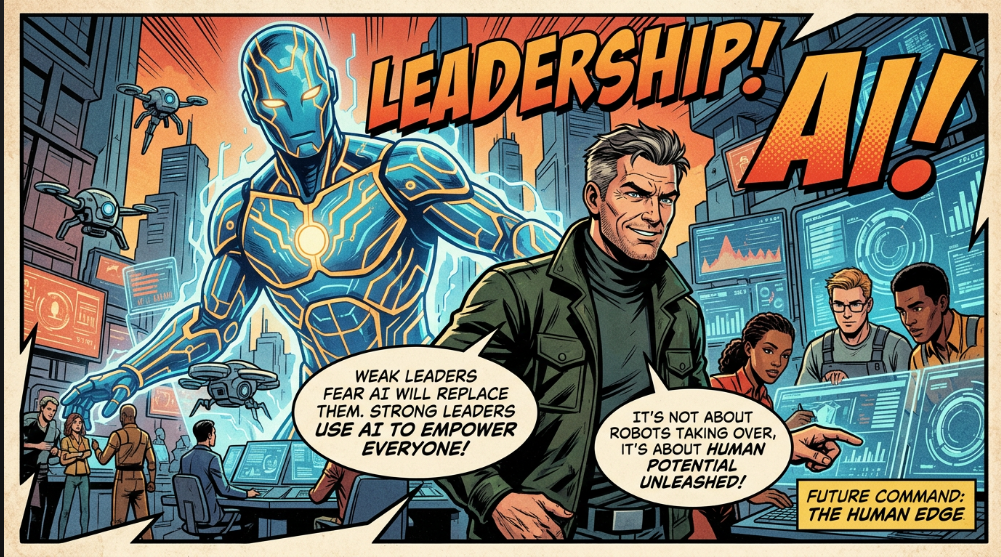
AI Does Not Replace Leadership —
It Exposes Weak Leadership.
Artificial intelligence is not a substitute for judgment, trust, priorities, or courage. It is a pressure test! Strong leaders use it to sharpen execution. Some leaders may use it to hide confusion — and the confusion shows, faster than ever before.
- Defined vision
- Defined mission
- Defined purpose
- Defined goals
- Owned decisions
- Clear priorities
- Knows desired results
- Lives accountability
- Scaled clarity
- Faster execution
- Better decisions
- Higher trust
- Multiplied output
- Visible wins
- Sustained results
- Stale vision
- Misaligned mission
- Purposeless
- Vague goals
- Decision Drift
- Weak accountability
- Faster noise
- Polished chaos
- Broken trust
- Leaders exposed
Read the Executive Summary and the Three Leadership Shifts. The strategic argument, in under five minutes.
Read Why It Matters and run the Readiness Diagnostic with your team before your next AI rollout.
The Accountability Architecture maps AI governance requirements onto named, owned leadership behaviors.
The Thesis
Executive Summary.
The organizations that benefit most from AI will not be the ones with the most tools. They will be the ones with the clearest leadership.
That has always been true about transformative technology. AI simply makes it measurably obvious — and it does so in weeks rather than quarters. AI can automate tasks, synthesize data at scale, accelerate content creation, and surface patterns that no human team could track manually. What it cannot do is decide what matters, repair a culture where people no longer trust each other’s judgment, know their purpose, clarify vague priorities, set ethical boundaries, or create genuine accountability.
Those remain irreducibly human leadership responsibilities. And because AI compresses the time between action and consequence, the absence of those things now produces visible failure almost immediately.
This is the sixteenth and final volume of the series. The earlier volumes built the case that AI advantage comes from human capability and governance, not technology acquisition. This volume closes the arc with the foundational truth beneath all of them: the quality of AI outcomes is a direct reflection of the quality of the leadership governing the system. Leaders must engage with AI directly, not hide behind experts or over-delegate the responsibility. They have to get in there and, yes, tame the beast. It’s the old accountability-versus-delegation argument in a new form. AI may amplify capability, but leadership remains irreducibly human.
The Mechanism
Why It Matters.
When organizations introduce AI into environments with ineffective leadership foundations, a predictable pattern emerges. The technology does exactly what it was designed to do — it works faster. But because the underlying systems rest on unclear goals, inconsistent standards, and avoided accountability conversations, the AI produces faster confusion, more polished ambiguity, and a higher volume of output that nobody is sure how to evaluate.
This creates a “leadership trap.” When AI-assisted work underperforms, the instinct is to blame the tool, the vendor, or the timeline. The harder diagnosis — that AI is revealing dysfunction that predated the technology — requires leaders willing to look hard in the mirror rather than at the machine.
Before your team asks what AI can do for productivity, ask what your leadership is doing for clarity, chain of evidence, and evaluation. AI will scale all of these.
— Dr. Bill / Thought Capital · Vol. 16Where the exposure is most predictable
- Decision quality. AI surfaces options and models scenarios faster than any analyst — but leaders still choose the tradeoffs. Leaders set the tone and provide a purposeful vision. Leaders who delegated decisions upward to side-step accountability now get better-formatted indecision.
- Communication. AI drafts messages and summarizes meetings — but it cannot create trust, tone, or meaning– purpose! Leaders who avoided hard conversations now avoid them with better-written avoidance.
- Culture. AI documents patterns and measures behavior at scale — but leaders still reward or correct what defines culture. AI just makes it harder to claim the patterns were invisible.
- Ethics and judgment. AI processes data within defined parameters — but leaders define those parameters, what should not be done, and where speed must yield to principle. That definition– that act– is a leadership act, not a technical one.
- Learning and adaptation. AI recommends training and identifies gaps — but leaders create the environments where people admit what they do not know and act on what they learn.
None of these failure modes is new. AI did not invent leaders who avoid hard conversations, reward appearance over performance, loyalty over competence, or let vague goals substitute for real priorities. What AI removed was the institutional lag time that used to buffer those failures from their consequences.
The Instrument
Run the Diagnostic.
Leaders do not need to become AI technicians. They need to become clearer about the work only leadership can do — and more deliberate about doing it before AI amplifies whatever is already present. Before your next implementation, run this diagnostic on the team you are deploying into. These are not technology questions. They are leadership questions.
The items marked Critical are leadership gaps, not technology gaps. They will not be resolved by a better model, a different platform, or a longer timeline.
Use AI friction as diagnostic data
When AI tools create friction — unexpected outputs, adoption resistance, quality problems — resist the instinct to troubleshoot the technology first. Treat the friction as data about the organization. What does it reveal about your standards? Your roles? Your feedback loops? Your trust? Strong leaders find this question useful. Ineffective leaders find it threatening. The response itself is information.
The accountability architecture
Every organization using AI at scale needs a simple accountability architecture: a map of which humans own which AI-assisted outputs, how those outputs are reviewed, and what happens when AI-assisted work causes error. This is not a technical document. It is a leadership declaration answering the one question technology cannot: who is responsible?
If any layer has no named owner, you have a governance gap — and it will appear in your AI outputs before it ever appears in your AI reports.
The Demand
Three Shifts AI Demands.
AI is not simply a productivity tool. It is an organizational stress test. The leaders who navigate it well are not those who understand the most about the technology — they are those who make three deliberate shifts in how they lead.
“Control”
- Authority through presence and approval
- Inspecting every output personally
- Breaks the moment work outruns review
“Clarity”
- Defined standards people can apply
- Judgment that scales without the leader present
- AI multiplies the clarity already set
Shift 02 — From busyness to judgment
AI compresses the work that used to fill leadership calendars: drafting, summarizing, scheduling, compiling, formatting. When that time returns, the question becomes uncomfortable — what does this leader actually do? Leaders with genuine strategic judgment use the reclaimed time to think, engage, and decide with better information. Leaders whose calendars were full of busyness find that busyness exposed as a substitute for judgment.
Shift 03 — From tool adoption to behavior change
The real implementation challenge is never installing software or selecting vendors. It is changing how people decide, communicate, review, and learn. An organization can deploy the most advanced platform available and see minimal improvement if the leadership behaviors governing its use stay unchanged. Conversely, an organization with mature decision habits and high psychological safety extracts value that less functional organizations simply cannot access — not because the tool is different, but because the people using it are.
The capability that determines AI advantage is not on any vendor’s pricing page. It is in the room where your leaders decide, communicate, and hold each other accountable.
— Dr. Bill / Thought Capital · Vol. 16The Table
What This Means for Every Seat.
This is not an AI-team concern. The exposure lands on every leadership role — and each inherits a specific version of it.
Clarity is now the product
Your standards propagate through every AI-assisted output in the building. Vague direction has never been more expensive to broadcast.
A competency to develop for
Leadership clarity and accountability become measurable selection criteria. Most assessment instruments do not yet capture them.
Governance is downstream of leadership
Your controls route well-governed work. But the behaviors that make governance real are set by leaders, not systems.
The new center of leader development
The curriculum shifts from tool training toward the judgment, clarity, and accountability habits AI now amplifies.
Diagnosis becomes strategic
Your oldest strength — reading the system before intervening — is exactly what determines whether AI scales value or noise.
The mirror is closest to you
Your team feels the amplification first. Clear standards and honest feedback are your highest-leverage AI investments.
Final Thought
Closing the Arc.
Across sixteen volumes, this series advanced a single argument from many angles: the competitive variable in the AI era is human capability and governance, not technology acquisition. Volume 1 argued that AI governance is alignment, not compliance. Volume 7 showed capability alignment determines what AI can deliver. Volume 10 established that AI agents require the same governance as human employees. Volume 13 demonstrated that executive problem architecture determines decision quality. Volume 15 insisted the consumer’s intelligence and agency matter as much as the enterprise’s.
This volume closes with the truth beneath all of them. AI is a mirror. It reflects, at scale and at speed, whatever leadership it is handed. The organizations that get this right will not be the ones that purchased AI earliest or most aggressively. They will be the ones that took the mirror seriously.
The Summary
Key Takeaways.
AI amplifies what is already present. Strong leadership becomes more scalable; weak leadership becomes more visible — and more costly.
The failure modes AI reveals predate the technology. AI removed the institutional lag time that buffered them from consequence.
Three shifts decide readiness: control → clarity, busyness → judgment, tool adoption → behavior change. None is on a vendor roadmap.
Next Move
Lead the System Before You Scale the Tool.
Before your next AI rollout, run the readiness diagnostic with your team. Choose one behavior to strengthen — clearer decision rights, better review standards, stronger feedback, or more honest communication. The technology produces better returns when the leadership foundation is steady.
Return to Top →