
The Future Workforce Already Has a Blueprint.
As organizations race to adopt AI, many leaders assume they are entering uncharted territory. They are not. The workforce is changing — but the principles for aligning it already exist. They were written for people, and they apply just as well to humans, AI agents, and the teams that blend them.
Most discussions about AI focus on tools — which model, which vendor, which platform, which controls. Those are real questions. They may not be the most important ones. Organizations have never won sustainable advantage by acquiring technology; they won it by aligning people, process, culture, leadership, and technology toward shared objectives. AI does not change that reality. In many ways, it magnifies it. The challenge is shifting from technology acquisition to capability orchestration — and that is, at its core, a workforce design problem.
The Hidden Assumption in Most AI Conversations.
The dominant conversation treats AI adoption as a procurement exercise: choose the model, sign the vendor, stand up the governance, declare transformation. Each of those steps matters. None of them, alone or together, produces advantage — because every competitor can buy the same model, sign the same vendor, and copy the same controls (generally).
History is consistent on this point. Electricity, the assembly line, enterprise software, the internet — each became a true advantage only for the organizations that redesigned how people worked around it; maybe even with it. The technology equalized; the capability to use it did not. AI will follow the same pattern, and faster.
From Human Capital to Capability Systems.
Traditional workforce planning asks how many people, with what skills, and recruited and developed how. Those questions remain. But a new category is emerging alongside them — questions that don’t fit inside headcount planning:
The New Workforce Questions
- Which work should humans perform?
- Which work should AI perform?
- Which work should be performed collaboratively, by humans and AI together?
- How many AI agents are required, and how should they be governed?
- Who develops the organizational capability to work effectively with AI?
These questions signal a shift from managing people to managing capability systems — systems whose contributors are both human and artificial, all pointed at the same organizational objectives. The unit of planning is no longer the headcount. It is the capability.
Why the Chief Talent Officer Becomes More Important — Not Less.
Many observers predict AI will shrink the importance of talent and HR functions. The opposite is more likely. Technology leaders can deploy systems. Policy leaders can establish governance. Finance leaders can evaluate the investment. But someone must develop organizational capability — AI literacy, human-AI collaboration skill, change readiness, leadership adaptability, psychological safety, and organizational learning to say the least!
That responsibility aligns precisely with the evolving role of the Chief Talent Officer. The CTO was always the architect of capability, not merely the administrator of training. In a mixed workforce, that mandate expands to include human capability development, AI capability integration, human-AI team design, agent workforce readiness, and the learning ecosystems that hold it all together.
The Rise of Human-AI Teams.
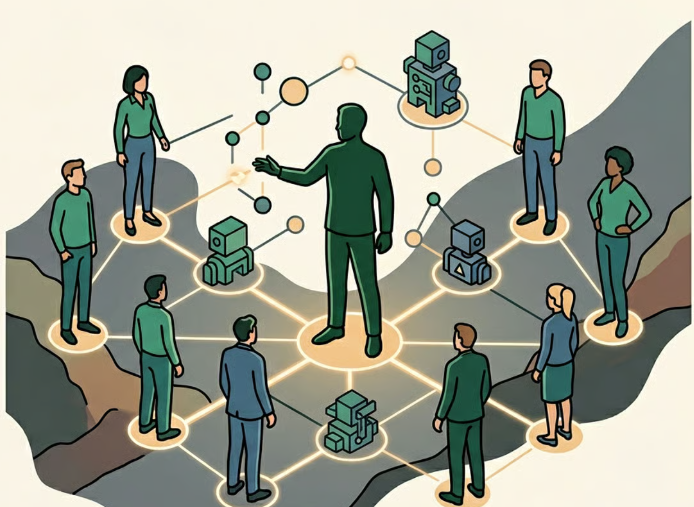
For decades, organizations optimized teams made entirely of people. Future organizations will optimize teams made of both. A business analyst supported by research, data-analysis, documentation, and quality-assurance agents. A project manager supported by scheduling, risk-monitoring, and communication agents. A leadership team supported by strategic-analysis, market-intelligence, and forecasting agents.
The managerial challenge shifts from supervision to orchestration. And the old span-of-control math breaks. A single leader may coordinate five human employees and twenty-five AI agents inside one operational system — not by supervising twenty-five workers in the traditional sense, but by orchestrating a capability system where humans set direction and judgment, and agents execute scoped, governed work. This is not science fiction. Elements of it already exist in production today.
| Dimension | Traditional Workforce | Capability System |
|---|---|---|
| Unit of planning | Headcount | Capability (human + artificial) |
| Manager’s core skill | Supervision | Orchestration |
| Span of control | 5–8 people | 5 people + 25 agents |
| Team composition | All human | Human-AI blend |
| Source of advantage | Talent acquired | Capability developed |
| Owner of readiness | HR / L&D | Chief Talent Officer as capability architect |
Total Alignment — for Human and Artificial Workforces.
Riaz and Linda Khadem’s Total Alignment framework connected vision, strategy, objectives, measures, and individual performance into a single chain (2017). The same chain applies to a mixed workforce — the only change is that “capability” now includes both human and artificial contributors:
The Alignment Chain — Unchanged in Form, Expanded in Scope
- Vision → Strategy → Initiative → Capability → Action → Outcome → Value → ROI
- Capability now spans human employees, AI agents, and human-AI teams
- Measured through Kirkpatrick Levels 1–4, Phillips Level 5 (ROI), and ATD Continuous Performance Improvement
Organizations that fail to align AI systems to vision and strategy will build impressive technology that produces limited business value — automation pointed at the wrong problems, fast. Organizations that align AI capability to strategic objectives create leverage that compounds for desired impact and results. The challenge was never whether AI can perform tasks. It is whether those tasks contribute to value creation — and that is an alignment question, which is to say, a talent and organizational development question.
The Capability Trap.
There is a failure mode worth naming, because it is the most common one. An organization buys the platform, runs the pilot, declares an AI transformation — and then plateaus. Productivity barely moves. The agents produce output no one trusts. The humans route around the system. Six months later, leadership concludes “AI was overhyped,” when what actually happened is simpler:
They purchased technology and skipped capability. They invested in the model and not in the literacy, the workflow redesign, the human-AI team design, or the leadership adaptation required to use it. Sophisticated AI cannot compensate for poor leadership, unclear strategy, or a misaligned culture — it executes them faster. The capability trap is believing the purchase was the transformation. The purchase was the prerequisite. The transformation is the capability work that most organizations never staff.
Why Capability Becomes the New Competitive Advantage.
Most organizations will eventually have access to similar models, purchase similar tools, and implement similar governance. The differentiator will not be the technology — it will be the capability to deploy it. Organizations that develop AI literacy, human-AI collaboration, organizational learning, leadership adaptability, and continuous-improvement cultures will outperform organizations with equivalent technology and weaker capability systems.
Technology can be purchased. Capability must be developed. In an era when everyone can buy the same intelligence, the organizations that can actually use it will be the ones that invested in the humans who orchestrate it.
The Blueprint Was Already Written.
The emergence of AI agents and autonomous systems does not render existing organizational frameworks obsolete. It validates them. Leadership development, talent management, organizational development, strategic alignment, continuous improvement, capability building — these disciplines were never really about managing people. They were about aligning capabilities to strategy and the vision. What changes now is the nature of those capabilities, not the principles for aligning them.
The future workforce will include humans, AI agents, autonomous systems, and human-AI teams. The central question is unchanged: how do we align capability to create value? What is the customer value stream? The answers are not found in a new framework but in applying proven organizational principles to an entirely new kind of workforce.
What to Do in the First 90 Days.
Executives
Reframe your AI initiative from a technology program to a capability program. Ask your team one question: “What is our plan to develop the organizational capability to use what we just bought?” If there isn’t one, that is your highest-priority gap — not the next tool.
Chief Talent Officers
Claim the capability-architect mandate before it is assigned elsewhere. Map your existing alignment, learning, and leadership frameworks onto the mixed workforce. You already own the blueprint; make that visible to the executive team.
Managers
Start practicing orchestration now, at small scale. Take one workflow, design it as a human-AI team with clear roles and governance, and learn the supervision-to-orchestration shift on something low-stakes before it is forced on you at scale.
The disciplines were never about managing people. They were about aligning capability to strategy and the vision.
What changes now is the nature of the capability — human, artificial, and the teams that blend them.
The organizations that recognize this earliest, and that empower the talent function to lead it, may gain the most durable advantage of the AI era.