

From Job Descriptions to Agent Specifications.
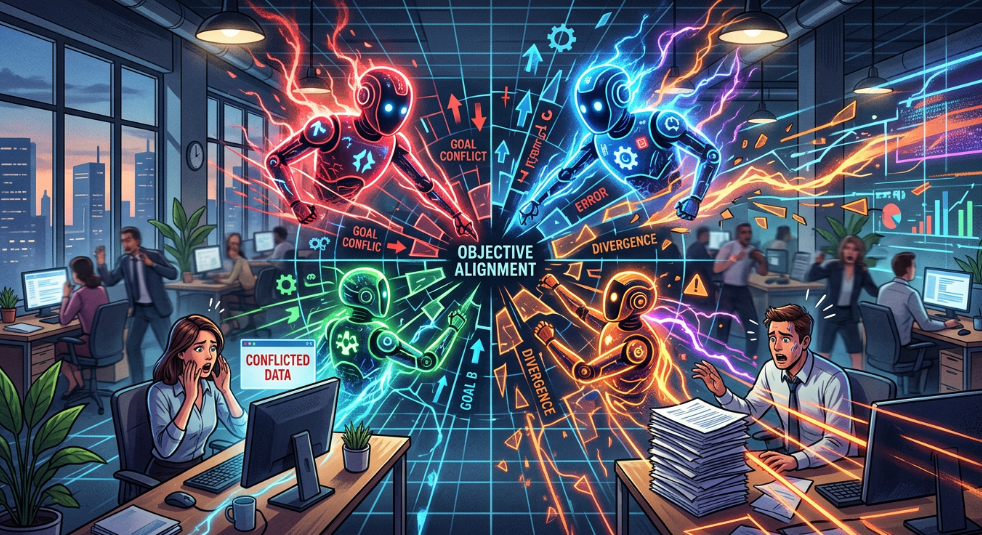
The AI world is bracing for the dramatic risk — machines that improve themselves faster than we can watch. But the risk most organizations will actually face is older, quieter, and entirely familiar: capable contributors, optimizing the wrong thing, with no shared specification to align them.
AI discussions fixate on building ever-more-capable agents — models, context windows, autonomous workflows, multi-agent systems. But an unexpected lesson keeps surfacing from practical AI development: before an organization can successfully deploy thousands of digital workers, it has to answer the same questions it has faced for decades managing human ones. The future challenge is not building intelligent agents. It is aligning thousands of human and digital workers toward shared outcomes — and the AI community is quietly rediscovering management’s oldest principle: people and systems perform better when expectations are clear.
An Unexpected Lesson from AI Development.
Consider a common development exercise. A developer asks an AI assistant to improve a website’s hero component. A simple prompt produces a reasonable result — but often with unnecessary complexity, inconsistent design choices, and features no one requested. Developers quickly learn that better results come from detailed instructions: purpose, goals, structure, required behaviors, design constraints, accessibility standards, future extensibility, performance expectations.
At first glance this looks like prompt engineering. A closer look suggests something else. It looks remarkably like a job description.
The Rise of the Specification.
Traditional organizations coordinate human work through job descriptions. Modern AI systems increasingly coordinate digital work through specifications. Set them side by side and the language differs while the management problem does not.
Job Description
- Mission
- Responsibilities
- Required skills
- Performance expectations
- Reporting relationships
- Growth opportunities
Agent Specification
- Purpose
- Goals
- Component structure
- Design principles & constraints
- Accessibility requirements
- Future enhancements
The specification is becoming the operating instruction for the digital worker. It is the job description of a workforce that doesn’t draw a salary.
Why Multi-Agent Systems Change the Conversation.
A single AI prompt can produce a useful result. A multi-agent system introduces an entirely different problem. Suppose five specialized agents are assigned to improve a website: one handles visual design, one accessibility, one animation, one responsiveness, one future extensibility. Without a shared specification, each agent optimizes for its own objective — and undermines the overall product in the process.
This should sound familiar, because organizations have lived it for decades. It has a name: sub-optimization. Sales optimizes revenue. Operations optimizes efficiency. Finance optimizes cost. HR optimizes compliance. Each department excels locally while the enterprise suffers globally. Multi-agent AI doesn’t invent this failure. It reinvents it — faster, and at greater scale.
Without alignment, optimization becomes fragmentation. That was true of departments for a century. It is about to be true of agent fleets — and the fix is the same one it always was: a shared specification everyone is measured against.
From Prompt Engineering to Workforce Engineering.
Much of today’s AI discussion asks the prompt-engineering question: how do I get better responses from a model? A more important question is emerging: how do I coordinate specialized human and digital contributors toward common objectives? That shifts the conversation from technology to organizational design — and it turns the specification from a technical document into a governance mechanism. A specification establishes shared expectations across distributed contributors. That is precisely what an org chart and a set of job descriptions do for human teams.
Recursive Self-Improvement — or Recursive Misalignment?
In early June 2026, Anthropic’s research institute published a widely-discussed proposal — covered by the Wall Street Journal, Fortune, and CNN — calling for a coordinated global pause in frontier AI development. Authors Marina Favaro and Jack Clark noted that more than 80% of code merged into the company’s own codebase is now written by its AI, and argued the trajectory points toward “recursive self-improvement” — AI systems autonomously designing and training their own successors without humans driving each step. The concern, in the company’s framing, is that the industry lacks a “brake pedal” to slow or pause development before companies risk losing control.
That is the dramatic risk, and it deserves serious attention. But there is a quieter risk that will reach ordinary organizations long before any model redesigns itself — and your own management experience already describes it. Call it recursive misalignment: not systems that get smarter than us, but systems that get more effective at achieving the wrong goals. Organizations have lived this for decades. Performance metrics drift from purpose. Departments optimize local objectives while harming the enterprise. Employees become highly skilled at the wrong things. AI doesn’t introduce that failure. It accelerates it — and, unlike recursive self-improvement, it is a problem the management discipline already knows how to fight.
That reframing matters for where a leader spends attention. The frontier-lab debate is real, but it is largely outside your control. Recursive misalignment inside your own operations is entirely within it — and the tools to catch it already exist.
Why Existing Management Frameworks Matter More, Not Less.
This is where decades of organizational practice become the asset. Frameworks built to connect activity with outcomes — Continuous Performance Improvement, ADDIE, Successive Approximation, Kirkpatrick’s evaluation model, Phillips ROI methodology, Strategic Workforce Alignment, Total Alignment — exist precisely to answer the questions an AI-enabled organization must also answer.
The Questions Every Framework Already Asks — Now Applied to Digital Workers
- Are we producing the desired behaviors?
- Are we producing the desired business results?
- Are we creating measurable value?
- Are we aligned with strategy?
These are the brake pedal an organization can actually build. Not a global treaty — a measurement layer. A specification defines what an agent is supposed to do; an evaluation framework checks whether what it actually did still serves the strategy. Run that loop continuously and recursive misalignment gets caught early, while it is still cheap to correct. The technology changes. The need for governance does not.
The Chief Talent Officer Opportunity.
AI cannot simply become another delegated responsibility — handed to one executive while the rest of the team disengages. The CTO cannot be given “AI” as a portfolio any more than the CEO, CFO, COO, or board can assume AI capability exists separately from organizational capability. Capability is capability. The future talent leader increasingly asks: which capabilities should remain human, which should be digital, which should be shared, how should they be measured, and how should they continuously improve? The challenge may no longer be workforce management. It may be capability ecosystem management.
The Specification Is the New Job Description.
A traditional organization coordinates work through vision, strategy, structure, job descriptions, performance measures, and continuous improvement. An AI-enabled organization coordinates work through vision, strategy, capability architecture, agent specifications, performance evaluation, and continuous improvement. The two lists are nearly identical — because human and digital workers increasingly operate under the same governance principles.
| Traditional Organization | AI-Enabled Organization |
|---|---|
| Vision | Vision |
| Strategy | Strategy |
| Organizational structure | Capability architecture |
| Job descriptions | Agent specifications |
| Performance measures | Performance evaluation |
| Continuous improvement | Continuous improvement |
What to Do First.
Write one shared specification before deploying a multi-agent system
If several agents work on one outcome, define the shared objective they all serve before defining their individual roles. That single document is what prevents sub-optimization — five agents each winning locally while the product loses.
Build the measurement loop, not just the agents
For every specification, define how you will evaluate whether the output still serves the strategy. The specification is the job description; the evaluation is the performance review. You need both, or misalignment compounds unseen.
Keep capability on the executive agenda, not in a silo
Don’t let AI become one leader’s delegated problem. Capability — human and digital — is an enterprise concern with a measurement chain from vision to ROI. Own it at the top.
Budget the governance before you scale the agents
Every agent you deploy has a cost: tokens consumed, API calls made, infrastructure used. At small scale this is invisible. Multiplied across departments and initiatives it becomes a significant and poorly-attributed line item. Build the cost model and the attribution mechanism before deployment — not after the CFO asks where $200K went.
The organizations that succeed may not possess the smartest AI. They may possess the strongest capability architectures.
The greatest competitive advantage of the AI era may come from an old management lesson rediscovered: clear expectations create better performance.
Whether the worker is human or digital, alignment remains the foundation of organizational success.