
Learning Was Never the Destination.
We have spent a century treating education as a line you walk from not-knowing to knowing, and then step off. But the people who keep growing are not walking a line at all. They are circling something — returning, each time, as someone more capable than the person who set out.
Ask most people what education is for and they will describe a line. You start at one end not knowing something, you move along it, and you arrive at the other end knowing it. The line has a beginning, a middle, and — crucially — an end. You finish the course. You pass the test. You earn the certificate. You are done. This is the model nearly all of us were handed, and it is so deeply assumed that we rarely notice it is a choice. But it is a choice, and it is the wrong one. The people who keep growing across a lifetime are not walking a line that ends. They are circling a center that does not. Figure 1 below is a concept I came up with called Adaptive Learning Experience and Environment Design Architecture (ALEEDA).
Figure 1. The Becoming Model
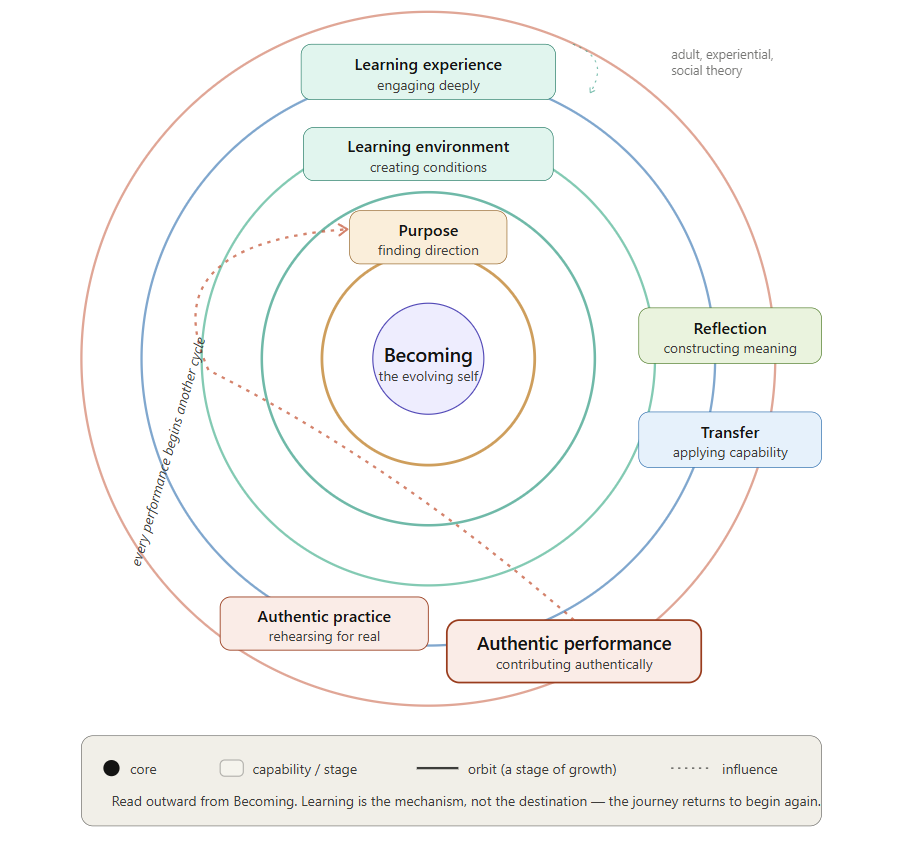
Note. Figure 1, the Adaptive Learning Experience and Environment Design Architecture (ALEEDA) Becoming Model, was developed by William E. Hamilton, Jr. (2026). Shared in the spirit of learning. You may reproduce and adapt this figure for educational and non-commercial purposes with attribution to the author.
This is the first piece in The Becoming Series — a new line of writing rooted in ALEEDA, the learning architecture behind CIWLEARNING and DrBill360. Where my work on AI and organizations asks how institutions adapt, this series asks something more personal: how does a human being actually grow? The answer has three parts — Becoming, the Journey, and the Destination — and this piece introduces all three.The Line We Were Handed.
The linear model of learning is not stupid. It is useful for some things — assembling a bookshelf, passing a driving test, memorizing the steps of a procedure. For bounded, finite skills with a clear “done,” the line works. The problem is that we took a model built for finite tasks and applied it to the whole of human development, where almost nothing that matters is finite.
Consider what the line quietly teaches. It teaches that learning has an endpoint — that there is a moment after which you have arrived and can stop. It teaches that the learner who finishes is essentially the same person who began, only now holding more facts. And it teaches that the goal is the knowledge itself: acquire it, store it, and the transaction is complete. Each of these is false to how real growth works, and together they produce a particular kind of disappointment — the graduate who has the credential and still feels unformed, the professional who has the training and still cannot perform, the person who did everything right and still has not become anyone new.
What the Line Cannot Hold.
Here is what a line cannot represent: the way that learning something changes who you are, and the way that who you are then changes what you are able to learn next. That is not a line. That is a loop. You do not simply accumulate capability the way a bucket accumulates water. You are transformed by what you learn, and the transformed you approaches the next thing differently. The learner is not the container. The learner is the thing being made.
Learning is not the destination. Becoming is.
That single reframe changes everything downstream. If becoming is the point, then learning is not the goal — it is the mechanism. Knowledge is not the prize — it is the fuel. The certificate is not the finish line — it is a waypoint on an orbit that has no finish line, because the self it is forming is never finished. This is not a motivational sentiment. It is a structural claim about how growth actually operates, and it has a shape.
The Shape of Becoming.
If growth is not a line, what is it? It is an orbit. Picture a center, and picture yourself circling it — moving outward through stages, reaching the edge, and returning to the center to begin again, but higher. Each pass around carries you through the same essential movements, and each pass leaves you more capable than the last. This is the architecture beneath everything in this series, and it has three parts worth naming clearly, because the rest of the series will return to them again and again.
Becoming
At the center sits the evolving self — not what you know, but who you are growing into. Everything orbits this. It is the origin of the journey and the thing the journey keeps changing.
The Journey
Around the core runs the journey — purpose, experience, reflection, transfer. This is where learning lives. Not as a destination, but as the motion that carries you outward and brings you back changed.
The Destination
At the rim is authentic performance — the moment capability meets the real world and becomes contribution. But it is not an end. Reaching it begins the next orbit. The destination feeds the return.
Read them together and the philosophy is complete in miniature. Becoming is the center you circle. The Journey is the motion of circling. The Destination is the outermost point of each pass — real, earned, and consequential — which then returns you to a new center to begin again. Three parts, one continuous motion. Figure 2 below is the methodology stack behind the model.
Figure 2. The Becoming Model Methodology Stack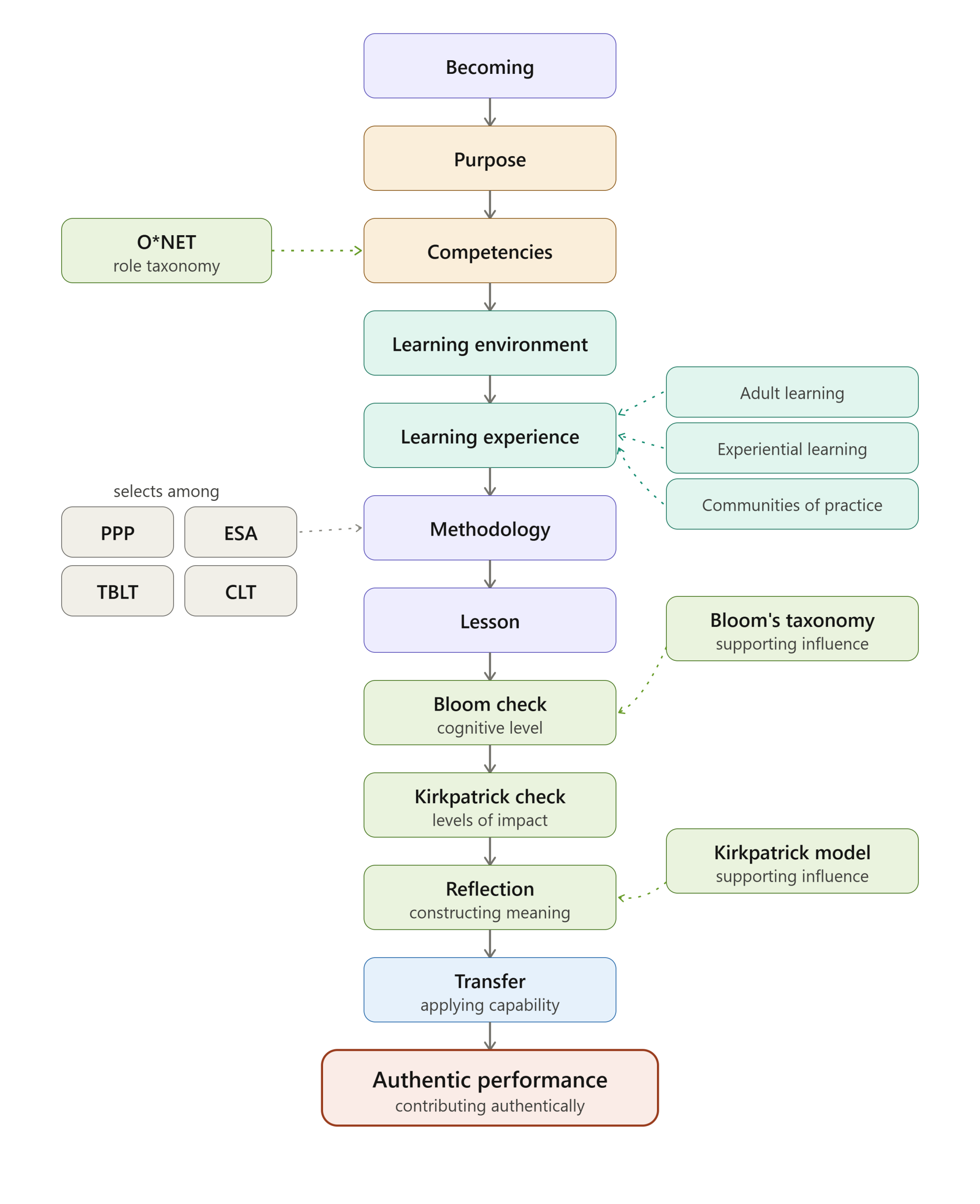
Note. Figure 2 developed by William E. Hamilton, Jr. (2026). Shared in the spirit of learning. You may reproduce and adapt this figure for educational and non-commercial purposes with attribution to the author.
The Difference Between Finishing and Becoming.
The traditional linear model produces people who finish. The orbital model produces people who become, including the methodology behind it! These are not the same, and the difference shows up everywhere once you start looking. The person who finishes asks “am I done?” The person who is becoming asks “who am I now, and what does that make possible?” The first question has an answer that ends the conversation. The second has an answer that opens the next one.
This is why some people seem to keep growing decade after decade while others plateau early. It is rarely about raw ability. It is about which model they are unconsciously running and the effort they put into it. The plateau is what happens when you believe you have arrived. The continued ascent is what happens when you understand that arrival was never the point — that every destination reached is the start line of the next orbit, and the self that reaches it is already different from the self that set out.
A Conversation, Not a Chain.
One clarification matters before this series goes further, because it is easy to hear “orbit” and imagine a rigid sequence — step one, then step two, then step three, forever. That is not it. The movements of the journey are not a chain of causes locked in order. They are a conversation among the elements of growth. Identity informs purpose. Experience deepens and sometimes reshapes that purpose. Reflection makes meaning of what was lived. Transfer carries that meaning into action. And authentic performance expresses what has been formed — creating a new becoming, and beginning the cycle again.
The journey is not linear. It is recursive. Each cycle returns you to the center, not as the same person, but as a more capable one. That is the whole idea, and everything else in this series is an exploration of it.
What This Series Will Do.
Over the coming pieces, this series will walk the orbit slowly. It will sit with Becoming — what it means to treat the self as the thing being formed rather than the container being filled. It will trace the Journey — purpose, experience, reflection, and transfer, each as its own movement. And it will arrive, again and again, at the Destination — authentic performance, the point where growth stops being private and becomes contribution to the world. The writing is rooted in a formal learning architecture called ALEEDA, but you will not need to know the architecture to follow the ideas. You only need to be willing to set down the line you were handed, and consider that you were never meant to walk it. You were meant to orbit. The series will also explore Becoming in terms of Bloom’s Taxonomy and concepts explored in my book, Fostering Global Citizenship in Education and Leadership (2025)
You were never meant to walk a line. You were meant to orbit.
Learning is the mechanism. Knowledge is the fuel. The certificate is a waypoint.
The destination was always the same — not a fact acquired, but a person becoming.