

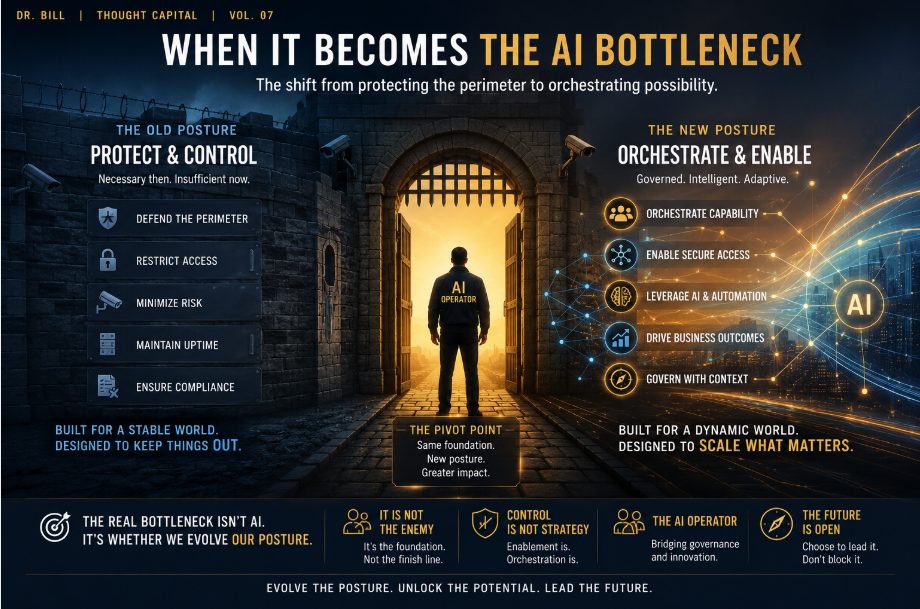
When IT Becomes the AI Bottleneck — And What to Do About It.
The next AI bottleneck inside most enterprises won’t be the model, the budget, or the strategy. It will be the IT department. Not because IT people are obstructive — but because the posture that protected the enterprise for two decades is structurally incompatible with the posture AI orchestration now requires.
Years ago I worked with a company whose strategy, vision, and learning roadmap all pointed to the same answer: they needed a Learning Management System. I recommended Moodle — open source, mature, defensible, exactly aligned with their stated mission. IT policy said no. The lockdown was so tight that the very capability the leadership team had asked for could not be installed. The workaround was to host Moodle externally, outside the corporate firewall, and let the value speak for itself. The same pattern is about to play out with AI — and at much higher stakes, because AI orchestration doesn’t just need to install. It needs to read, write, coordinate, and act across systems the IT department has spent years locking down.
The Honest Statement Most Leaders Won’t Say Out Loud.
The biggest AI bottleneck inside most enterprises right now isn’t the model. It isn’t the budget. It isn’t the strategy. It is the IT department.
I’ll say it plainly because the people watching their AI initiatives stall already know it — they just haven’t had permission to name it. Most corporate IT environments are locked down to a degree that will block agentic AI before it ever delivers value. That is not a moral statement about IT professionals, almost all of whom are doing exactly what their organizations have asked them to do for the last twenty years. It is an architectural statement about a posture that no longer fits the work.
Agentic AI needs to read, write, and act on files across the network. It needs persistent context, tool access, and the ability to coordinate across systems. Under current security postures inside most large enterprises, that will not be permitted. And until it is, AI investment produces a fraction of its possible value.
The technology has arrived. The architecture has not. The gap between them is staffed by professionals doing exactly what they were trained to do — defend the perimeter. The problem is that the work no longer fits inside the perimeter.
This Is a Posture Problem — Not a People Problem.
Let me draw the distinction precisely, because it is the most important sentence in this article: IT professionals are not the bottleneck. The infrastructure posture they have been asked to maintain is the bottleneck.
That posture — call it the infrastructure mindset — was the right answer for the last two decades. Lock the perimeter. Approve the software stack. Standardize the endpoints. Audit the changes. Defend against threats. Every one of those instincts protected the enterprise through cloud migration, BYOD, mobile, and a generation of cyber threats. None of them should be discarded.
But they are insufficient for what comes next. The orchestration mindset AI requires is a different operating discipline — not the opposite of the infrastructure mindset, but the next layer above it.
| Dimension | Infrastructure MindsetThe IT Posture That Built the Enterprise | Orchestration MindsetThe IT Posture AI Now Requires |
|---|---|---|
| Default stance | Restrict by default | Govern by design |
| Primary deliverable | Uptime and security | Uptime, security, and orchestrated capability |
| Posture toward new tools | Block until vetted | Sandbox until governed |
| Approach to data access | Least privilege, indefinitely | Least privilege, dynamically expanded under oversight |
| Role of policy | Defensive perimeter | Risk-tiered enablement framework |
| Measure of success | No incidents | No incidents + measurable value released |
| Time horizon | Defend the present | Architect the next era |
| Relationship to AI | Threat surface | Operational capability |
Read the right column carefully. Nothing there discards security, governance, or rigor. It expands them. Orchestration is not the absence of discipline — it is discipline applied at a higher altitude.
The Five Forms of Policy-Driven Resistance.
The friction shows up in patterns. Recognize these inside your own organization and you have already done half the diagnostic work.
Block-First Procurement
New AI tools cannot be evaluated because they cannot be installed. The procurement review cycle is measured in quarters, not weeks. By the time the tool is approved, the use case has either passed or been solved by a shadow workaround.
Endpoint Lockdown
Workstations are managed so tightly that AI-assisted development environments, agentic tools, and orchestration runtimes cannot operate. The very functions that would deliver value are filtered out by policy that was written when “browser plugin” was the riskiest thing on the agenda.
Data Boundary Rigidity
AI needs context from across the enterprise — documents, communications, prior decisions, organizational standards. Current data classification regimes treat that aggregation as the threat instead of the requirement. Result: AI gets deployed against a tiny slice of available context and underperforms predictably.
Network Egress Filtering
AI APIs, MCP servers, and orchestration platforms require outbound network access. Default egress policies block them. Exceptions are processed individually, slowly, and only after escalation — which trains the business to stop asking.
Approval Chain Fatigue
Every meaningful AI integration touches security, compliance, legal, and infrastructure. Each owns a veto. None owns the outcome. Initiatives die not from a “no” but from indefinite “review” — which is operationally identical to no, while preserving deniability.
The Capability Gap Behind the Friction.
Behind the policy-driven resistance is a capability gap that nobody wants to name. Most enterprise IT teams have not been resourced or trained to operate in the orchestration paradigm because the orchestration paradigm did not exist when their roles, budgets, and reporting structures were designed.
Ask an honest CIO what percentage of their team has working hands-on experience with agentic AI orchestration, MCP ecosystems, context engineering, or AI governance frameworks like ISO/IEC 42001 and NIST AI RMF, and the answer is almost always less than 15%. That is not a criticism of IT. It is a candid statement about a discipline that is younger than the average enterprise IT initiative.
The vision came from leadership at machine speed. The capability lives in IT at infrastructure speed. The gap between those two speeds is where most enterprise AI initiatives die quietly.
Five Warning Signs Your IT Department Is About to Become Your AI Bottleneck.
If three or more of these are true in your organization, you already have the problem — you just have not labeled it yet.
Self-Diagnostic — AI Bottleneck Risk Indicators
- Leadership has announced AI initiatives that have not produced measurable value within twelve months of announcement
- Frontline teams are running shadow AI workflows outside the corporate environment because the inside is blocked
- No one in your organization can answer the question “who governs AI-produced work, and against what standard?” without naming three departments
- Your data classification and access policies were last reviewed before generative AI was a board-level topic
- IT roadmap and AI roadmap are separate documents owned by different leaders, with no mapped interdependencies between them
What the IT Function Becomes, Not What It Loses.
Here is the part of this conversation that almost never gets said: the IT department’s path through this transition is not contraction. It is expansion — but only for the organizations and the IT leaders who choose it.
In the orchestration era, IT is no longer just the function that keeps systems running. IT becomes the function that designs, sandboxes, and governs the AI orchestration architecture on which the entire business now depends. That is more strategic work, not less. More budget, not less. More executive seat-at-the-table, not less.
The new IT capability stack looks like this:
AI Sandbox Architecture
Design environments where agentic AI can read, write, and act safely against real organizational systems — under containment, with full audit trail. Sandboxing is the new perimeter.
Risk-Tiered Enablement Policy
Replace block-by-default with govern-by-design. Different tiers of AI action carry different approval requirements — fast lane for low-risk, dual review for consequential, full board for strategic.
Context Engineering and Data Plumbing
Build the data, document, and metadata flows that let AI operate against full organizational context with appropriate access controls. This is the modern equivalent of the data warehouse — and just as foundational.
Orchestration Governance Frameworks
Implement ISO/IEC 42001, NIST AI RMF, and adjacent frameworks as operating disciplines, not compliance overhead. The IT department becomes the institutional steward of how AI is governed end-to-end.
Partnership With the AI Operator Class
The emerging AI Operator role (see Vol. 05) cannot function without an IT department that supplies the platform, the policy framework, and the operational backbone. The two roles are partners, not adversaries.
The Coordination Architecture That Resolves the Tension.
Putting it together: the way out of the IT-as-bottleneck pattern is not to reduce IT’s authority. It is to expand IT’s mandate while creating a parallel coordination layer staffed by AI Operators who interface with IT through a defined operating model. Three layers, three accountabilities, one outcome:
What Each Audience Should Do First.
To Corporate Leadership
Your AI strategy will not deliver value until your operating posture changes. The question is no longer whether to invest in AI — it is whether your IT architecture, your policy framework, and your talent strategy let that investment land. If the gap between your AI vision and your IT capability is wide, your competitors who close it first will outpace you for a decade. This is not a tooling decision. It is an operating-model decision, and it sits at the board level.
To IT Leadership
You have a choice nobody else can make for you. You can defend the infrastructure mindset and watch the business route around your function — fast, expensive, and probably fatal to your role in the long run. Or you can lead the redesign and own the orchestration layer that the next decade of enterprise value will be built on. The work expands either way. Whether you lead it or are bypassed by it is the open question.
To Professionals Inside IT
Your skills are not obsolete — they are foundational to what comes next. The professionals who build AI sandboxes, design risk-tiered enablement policy, implement orchestration governance, and partner with AI Operators will be among the most valuable people in their organizations within three years. Start now. The org chart has not caught up yet, which is exactly why the window is open.
To the Business
Stop routing around IT and start staffing the coordination layer. Shadow AI workflows feel productive in the short term and create existential risk in the medium term. The right play is to fund and elevate the AI Operator role, partner it formally with IT, and build the architecture that makes both functions stronger.
The companies that win the next decade will not be the ones who replaced their IT department. They will be the ones whose IT department led the redesign.
The bottleneck is not IT. It is the posture IT was asked to maintain.
The same people doing the same caliber of work, operating from a different posture, are exactly who builds the AI orchestration architecture of the next decade.
The infrastructure mindset built the enterprise we have. The orchestration mindset will build the enterprise we need.