

An Honest Look at AI for Regular People– the Audience It Forgot
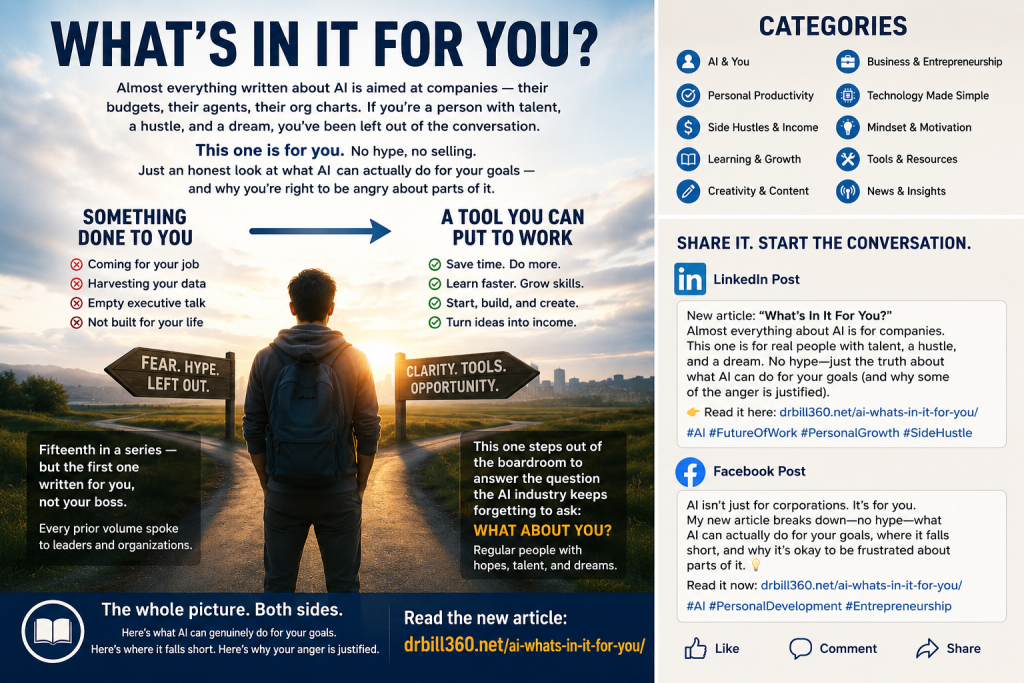
What’s In It For You?
Almost everything written about AI is aimed at companies — their budgets, their agents, their org charts. If you’re a person with talent, a hustle, and a dream, you’ve been left out of the conversation. This one is for you. No hype, no selling. Just an honest look at what AI can actually do for your goals — and why you’re right to be angry about parts of it.
Let me guess how the AI conversation has felt from where you’re standing. Either it’s coming for your job, or it’s harvesting your data, or it’s a bunch of executives on stage talking about “transformation” in a language that has nothing to do with your life. Nobody’s been straight with you about what’s actually in it for you — the person with real talent, a side business or a dream of one, and not a lot of spare time or money to figure out one more complicated thing. So that’s what this is. Not a sales pitch. An honest accounting from someone who spends all day thinking about this: here’s what AI can genuinely do for your goals, here’s exactly where it falls short, and here’s why some of the anger you may feel about it is completely justified. You deserve the whole picture, both sides.
You’re Already Doing the Hard Part.
Here’s something the AI hype machine misses completely. If you’re making things — crafts, custom shoes, painted bottles, gift sets, art, food, anything — you are already doing the part that’s genuinely hard. The talent. The taste. The eye. The hustle to find customers. The nerve to charge for your work. None of that comes from a machine, and none of it ever will. That’s yours.
What you may not have — what most talented people building something on their own don’t have — is the back office. The marketing copy. The product descriptions that make someone hit “buy.” The pricing strategy. The research into where to get materials cheaper. The polite-but-firm message to the customer who’s ghosting you on a payment. The bookkeeping. The business plan you keep meaning to write. Those things used to require either money you’d rather spend on supplies, or hours you don’t have after everything else in your day.
That’s the gap. And that gap — not the talent — is what keeps a lot of gifted people small.
AI isn’t here to make your art. You already do that better than it ever could. It’s here to be the assistant your business couldn’t afford to hire yet.
What That Actually Looks Like.
Let me make this concrete, because vague promises are exactly what made you distrust this in the first place. Here are real things you could ask an AI assistant to do today — things that used to cost money or simply go undone. Think of each as a first draft you couldn’t previously afford, not a finished product.
Write the words that sell your work
Paste in a photo description of what you made and ask for three product descriptions in different styles. You pick the one that sounds like you, fix it up, and post it. The blank page — the thing that stops most people — is gone.
Help you figure out what to charge
Tell it your materials cost, your time, and what you’re making. Ask it to walk you through pricing options and what similar makers charge. It won’t decide for you, but it’ll end the guessing that has you undercharging.
Handle the awkward messages
The customer who won’t pay. The order that went wrong. The wholesale inquiry you don’t know how to answer. Describe the situation, ask for a professional, friendly reply, and edit it to your voice. It takes the dread out of the inbox.
Be the business advisor you can’t hire
“I sell handmade crafts and want to grow. Ask me questions and help me make a simple plan.” It can draft the skeleton of a business plan, a grant application, or a booth-fee budget — a starting point an advisor would’ve charged you for.
Translate the confusing grown-up paperwork
A lease, a medical bill, a tax form, a contract for a craft fair. Paste it in and ask “what does this actually mean, and what should I watch out for?” It won’t replace a lawyer, but it’ll help you walk in understanding instead of intimidated.
Be a patient teacher at 11pm
Want to learn a new skill, study for something, understand a topic? It’ll explain things as many times as you need, in plain language, without making you feel small for asking. That kind of patient help used to cost money too.
Notice what every one of those has in common: you’re still the one in charge. You’re directing the work, making the calls, providing the talent and the taste. The AI just clears away some of the friction that’s been standing between you and the next level. That’s the real story nobody’s telling you — not that AI does it for you, but that the starting line just moved closer for people who were never given a head start.
The Only Skill You Actually Need.
You might be thinking: that’s fine for tech people, but I’m not technical. Here’s the truth that the whole industry has buried under jargon — the one skill that matters with these tools isn’t a tech skill at all. It’s being able to say clearly what you actually want.
That’s it. If you can explain a problem to a friend, brief someone on a job you need done, or tell a doctor what hurts, you already have the skill. You describe what you want, look at what comes back, and say “no, more like this.” That back-and-forth — that’s the whole game. You’re not learning to code. You’re learning to ask, which you already know how to do.
You don’t need to be technical, employed in tech, or running a company to be the one giving the orders. You need a goal and a willingness to ask. You already have both.
You’re Right to Be Angry, Too.
Here’s where I refuse to sell you something. You may have a bad feeling about AI that goes beyond “what’s in it for me” — a sense that it’s being built in a way that costs everyone something while a few companies get rich. That instinct is correct, and you should hold onto it even as you use these tools.
The machines behind AI live in enormous data centers, and their environmental cost is real. A United Nations University report released in June 2026 found that by 2030, AI-driven data centers are projected to consume nearly 945 TWh of electricity annually– enough that, if they were a country, they would run among the world’s largest electricity consumers. The report estimated AI-related water use could eventually equal the basic needs of over a billion people. These facilities get built in real communities — often ones that didn’t get much say — and researchers have linked the buildout to rising electricity costs for ordinary households nearby.
And the response from Washington? Thin. There’s no serious federal framework holding this buildout accountable for what it costs communities in power, water, and higher bills. That’s not your imagination, and it’s not paranoia. You can find a tool genuinely useful and still be right to be furious about how it’s being built and who’s paying for it. Those two things aren’t in conflict. Holding both at once isn’t hypocrisy — it’s just seeing clearly. https://unu.edu/inweh/collection/environmental-cost-of-AIs-Enrgy-Use-Carbon-water-and-land-footprints?utm_source=chatgpt.com
So use these tools with your eyes open. Get the value that’s rightfully available to you — you’ve been left out long enough. And keep your anger about the harms, because that anger is what eventually forces the people in charge to build this better. Being a smart, demanding user who knows both sides is a stronger position than either blind enthusiasm or total rejection.
The Honest Limits, Spelled Out.
I promised no hype, so here’s the fine print plainly, before you go try any of this:
What AI Will Not Do For You
- It won’t make your product, take your photos, or supply your talent — that’s still all you
- It’s wrong sometimes, confidently, so it’s best for first drafts and low-stakes things, not final medical, legal, or money decisions
- It doesn’t replace a doctor, lawyer, or accountant — at best it helps you show up prepared instead of intimidated
- It needs internet access and a little confidence to start, and the people who’d benefit most often have the least spare time to learn it — that’s a real unfairness, not a slogan
- The free versions are genuinely useful; you do not need to pay for the expensive ones to get most of this value
Where to Start.
Not a course. Not a purchase. Just one small thing this week.
Pick one annoying task
The one back-office chore you dread most — the product descriptions, the pricing, the awkward email. Just one. Don’t try to learn “AI.” Try to solve one real problem you actually have this week.
Ask like you’d ask a person
Open a free AI tool and describe your situation in plain words, like you’re explaining it to a helpful friend. Tell it who you are, what you make, and what you need. Then react to what comes back: “shorter,” “warmer,” “more like me.”
Keep what’s yours, fix the rest
Whatever it gives you is a draft, not gospel. Keep the parts that sound right, change the parts that don’t, throw out what’s wrong. You’re the editor, the boss, the talent. It just handed you a starting point you didn’t have before.
You were never the afterthought in this story. You just got treated like one.
The talent is yours. The dream is yours. The hustle is yours. AI doesn’t change any of that — it just clears away a little of the friction that’s been keeping you smaller than you deserve to be.
Use it with open eyes. Demand better from the people building it. And don’t let anyone tell you this conversation was never about you. It should have been about you all along.